I installed my first Linux distro in 2022: Pop!_OS.1
It didn’t take long before I did the thing everyone does after the first successful install: I started hopping. Fedora. Arch and even Nobara Project by GloriousEggroll.2 3
By the end of 2023 I bought my first Mac, and that did solve a lot of day-to-day friction for me—but it didn’t cure the Linux itch.
I think that’s the part people miss when they reduce Linux desktop to a niche alternative. Once you get used to an ecosystem that builds in public, where the plumbing is discussed openly and you can see the tradeoffs, it’s hard not to keep checking back in.
But most people don’t “choose an OS,” they just buy a computer. And yes—Linux on desktop is still small today. StatCounter’s desktop numbers are still low single digits for Linux; for example, December 2025 shows Linux at 3.86% worldwide.4
So here’s where I’m landing: I think 2030 is the first year where desktop Linux can realistically stop feeling like a hobbyist choice and start feeling like a normal choice. Not because one magical breakthrough happens, but because a bunch of important details are finally lining up.
The Nvidia story is finally getting interesting
One reason AMD and Intel often feel easy on Linux is simple: their graphics stacks are largely upstream-first. The kernel side (DRM/KMS), userspace (Mesa), and the compositor stack tend to evolve together, with fewer vendor-specific special paths needed for the common desktop workflows.56
Nvidia has historically been harder because the stack has been split across two paths.
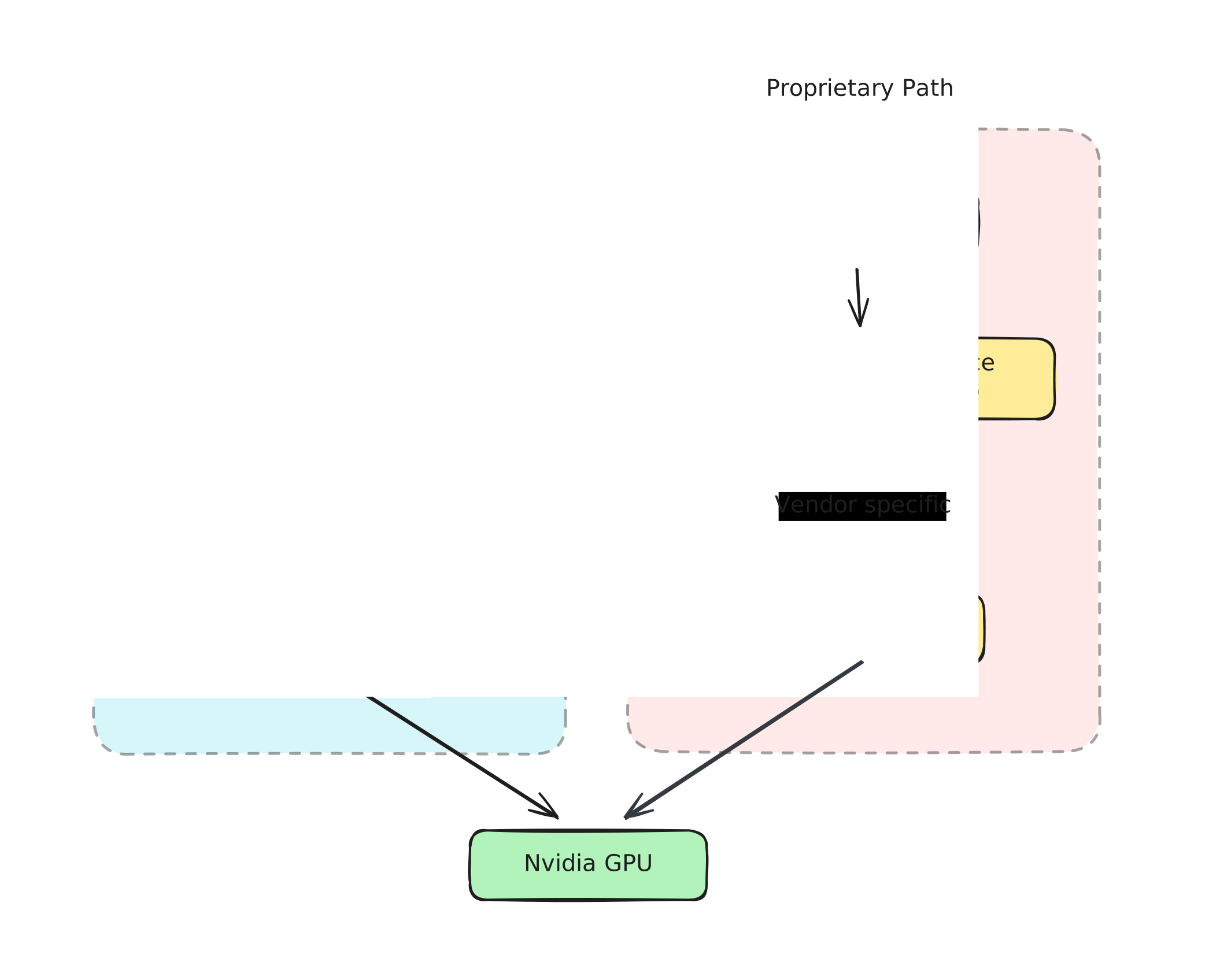
Fragmented past stack.
On one side there’s the community stack (Nouveau + Mesa), where the kernel driver and Mesa drivers are developed in the open and integrate naturally with the upstream graphics stack.
On the other side there’s the proprietary Nvidia driver, where kernel modules and the userspace OpenGL, Vulkan and EGL implementation are delivered as a vendor stack, and historically have lagged or diverged on integration points that matter on modern Linux desktops.7 8
What’s changing is that both paths are moving in directions that reduce the number of special cases needed for Nvidia to behave like any other GPU on Linux.
On the Mesa side, NVK is now a serious part of the plan. NVK is Mesa’s open-source Vulkan driver for Nvidia GPUs. Mesa documents it as a conformant Vulkan 1.4 implementation for supported Nvidia generations.9
What makes NVK especially relevant to desktop users is how it pairs with Zink.
Zink is a Mesa OpenGL implementation built on top of Vulkan. Instead of maintaining a hardware-specific OpenGL driver backend for every GPU family, Zink implements OpenGL once and emits Vulkan calls underneath.
In practical terms, this consolidates effort around the Vulkan driver path (NVK) and reduces reliance on the older Nouveau OpenGL driver for modern Nvidia cards.10
Then there’s Nova.
Nova is a new upstream Linux kernel driver project for Nvidia GPUs that use the GSP (GPU System Processor) model. The kernel documentation describes Nova as two drivers—nova-core and nova-drm—and states that it intends to supersede Nouveau for GSP-based Nvidia GPUs.
nova-core provides the low-level firmware/hardware abstraction, and nova-drm is the DRM/KMS piece that plugs into the normal Linux graphics stack.11
Why this matters is straightforward: NVK and Zink live in userspace (Mesa), but they still depend on a functional kernel DRM driver for memory management, command supmission, display, and synchronization. Today that kernel foundation is generally Nouveau on the open stack; longer-term, Nova is the path aimed at being the modern upstream kernel foundation for newer Nvidia generations using GSP.
That is how NVK + Zink can eventually sit on top of a kernel driver that is designed for the modern firmware model and developed upstream alongside the rest of Linux graphics.12 13
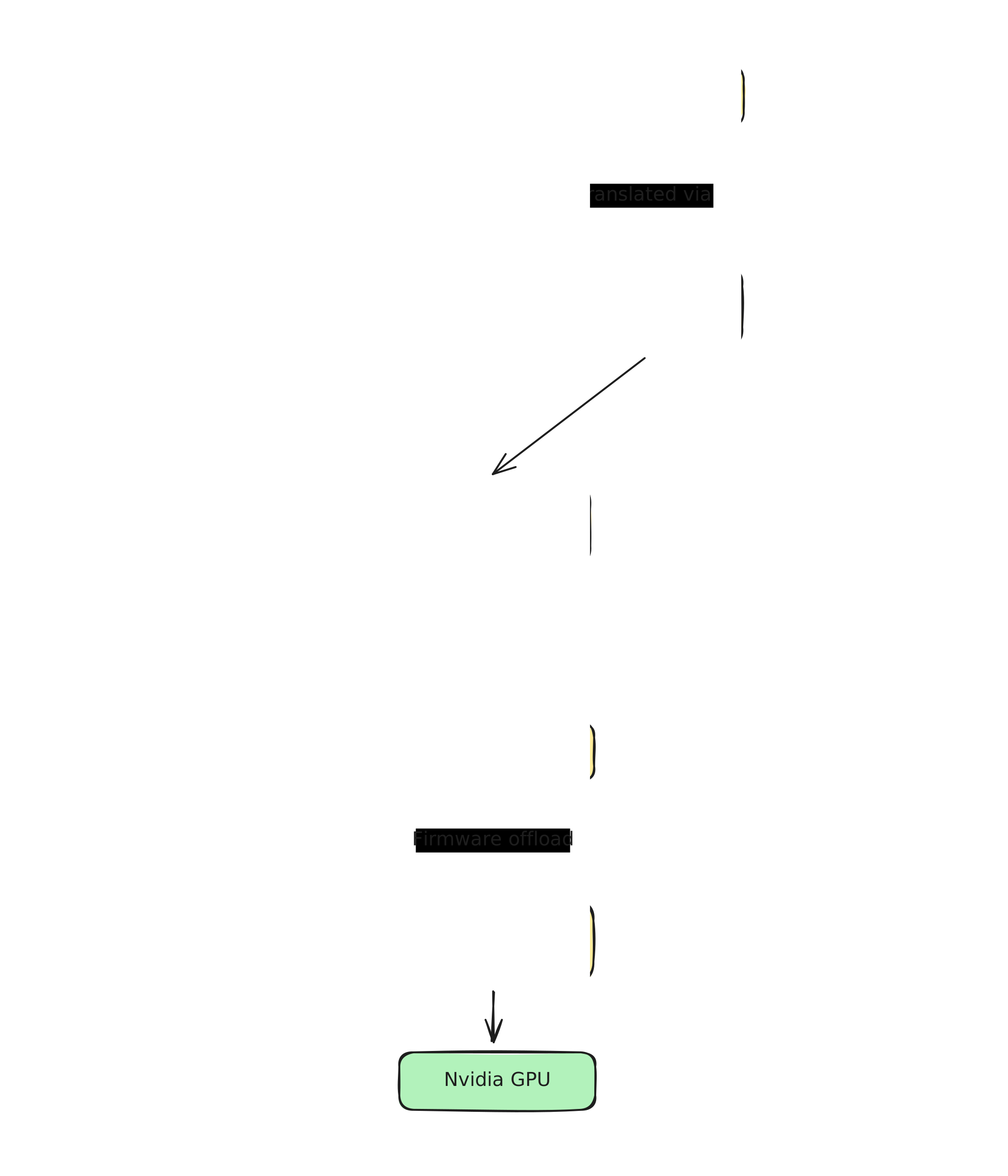
Unified modern stack.
Meanwhile, on the proprietary side, Nvidia has also been addressing some of the most visible Wayland pain points. The 555 driver series added support for the linux-drm-syncobj-v1 Wayland explicit sync protocol, which is one of the missing pieces that historically contributed to stutter, flicker and timing issues on some Wayland setups.14 15
There’s also a second category of problems that matters specifically for Linux adoption among gamers: DirectX 12 through Proton.
DirectX 12 games on Linux usually run through Proton using VKD3D-Proton, which translates D3D12 calls to Vulkan. When performance is worse on Nvidia than expected, or when certain D3D12 titles regress, the cause is often a messy interaction between translation-layer assumptions and driver behavior. Nvidia users have been reporting these issues publicly for a while, including performance complaints in Nvidia’s own Linux forums.16
What’s relevant here is that there are signs Nvidia is actively targeting general improvements for D3D12 and VKD3D workloads on Linux, rather than only one-off game fixes, which is exactly the kind of work that can move the baseline instead of just patching symptoms.17
And this matters because Nvidia isn’t a niche vendor in the gaming world—it’s still the default GPU choice for a huge portion of Steam users.18
Most of these users will never learn what NVK, Zink, or Nova are—and they shouldn’t have to. The only metric that matters is the experience: you launch a game, you launch an app, you alt-tab, you drag a window across monitors, and nothing weird happens.
If the Linux experience becomes smoother on the hardware people already own, the adoption story changes.
Wayland becomes the baseline
Wayland used to be the future. Now it’s increasingly just the default.
KDE has been explicit about moving Plasma toward a Wayland-exclusive future, with Xwayland used for legacy X11 apps rather than maintaining parallel desktop sessions indefinitely.19 GNOME is moving the same way: the X11 session was disabled by default and the project targeted full removal during the GNOME 50 cycle, leaving Wayland as the only supported session, but also with Xwayland for X11 apps.20
What I expect over the next four years isn’t “Wayland is done,” but something more practical: protocols that are currently debated, drafted, and sitting in review will either land, consolidate, or be replaced by clearer approaches.
That process matters because paper cuts on Wayland are often not compositor bugs—they’re missing or incomplete protocol agreements that everyone is waiting on.
Wayland protocol development can leave even basic functionality sitting for months or years, and that becomes a product problem when you’re shipping devices and a compositor (Gamescope) to real users.
This is where Valve’s frog-protocols exists.
Frog-protocols isn’t a new Wayland replacement.21 It can server as a fast-moving proving ground where protocols can be shipped, exercised by real users, and then folded back into the upstream process once the shape is clear.22 23
One concrete example is frog-fifo-v1. The stated goal is to address FIFO/VSync behavior under Wayland in cases where applications can end up in bad states (including GPU starvation and freezes when windows are occluded with FIFO/VSync enabled).24
Wayland also pairs well with another shift that makes the Linux desktop feel more coherent: the security and permissions model is getting a default path.
Flatpak’s sandboxing model is restrictive by default, and portals provide a consistent interface for sensitive operations. That doesn’t make Linux magically secure, but it does move desktop Linux toward a platform model instead of a loose collection of conventions.25 26
Compatibility stops being a philosophical argument
I don’t think Linux wins because people suddenly care about freedom. I think it wins when the question becomes, “Can I run my stuff?”
This is why I pay attention to the compatibility work.
Wine’s Wayland driver work is a good example. The goal is to make Windows apps on Wayland a first-class path, not something that relies on legacy X11 behavior. When that upstream work matures, it reduces the amount of X11 surface area Linux desktops still need to keep around for compatibility.27
On the gaming side, SteamOS being treated as a product line matters too. It forces investment into Linux gaming as a first-class experience.28
A big reason that experience feels real now is Proton. Proton is a stack of translation layers and fixes that keep getting hammered into shape by real users at scale.29
But there’s one compatibility cliff that turns this into a very non-philosophical argument: kernel-level anti-cheat.
A lot of competitive multiplayer games rely on anti-cheat systems designed around deep Windows integration, including kernel-level drivers. Call of Duty’s RICOCHET, for example, explicitly uses a PC kernel-level driver as part of its approach.30 In that world, it’s common for a game to run perfectly well under Proton—until matchmaking is blocked, the client is kicked, or the anti-cheat refuses to initialize.
The frustrating part is that the ecosystem already has a workable pathway. Epic introduced Easy Anti-Cheat support for Linux, but enabling it is ultimately a developer or publisher choice.31 BattlEye has a similar story: Proton support exists, but it’s opt-in per game.32 So you end up with a strange middle ground where compatibility is technically possible, culturally inconsistent, and commercially uncertain.
This is why the discussion is hard: the incentives don’t line up cleanly. Studios don’t want to expand their attack surface for a relatively small slice of player base with full control over your system, and players don’t want to adopt a platform that locks them out of their most-played competitive titles.
So yeah: it’s a chicken-and-egg problem. Companies are more likely to take Linux seriously when it’s a meaningful chunk of their revenue. But Linux only becomes a meaningful chunk of revenue if more people decide to use it anyway—even knowing that not every favorite game or app will work 100% on day one. That early tolerance is how market share grows.
My bet is that the long-term escape hatch is less client trust and more server authority: more server-side validation, better telemetry, stronger behavior analysis, and maybe ML-assisted detection where it actually makes sense. But then you hit the question that decides everything: will the ROI ever justify the investment?
I hope we have better answers by 2030.
PCs shipping with Linux stops feeling rare
Most people don’t install an OS. They buy whatever shows up on the machine.
That’s why OEM momentum compounds. Dell shipping Ubuntu preinstalled on XPS Developer Edition models is a small example, but it’s the kind of thing that normalizes the idea that Linux can be the default.33 34
If that expands—more models, more regions, more validation—then the first-run experience becomes less fragile. And once first-run is predictable, word-of-mouth gets dramatically easier.
A second-order effect is that rising interest in Linux makes it rational for some companies to treat the OS as part of the product, not just a removable software layer.
System76 is the obvious reference point here: they sell hardware designed, tested, and supported around their own distro (Pop!_OS), and the preinstalled with a validated stack approach removes a lot of first-boot uncertainty for end users.35 36
You can see a similar dynamic starting to appear in handhelds. Valve has been explicitly expanding SteamOS beyond the Steam Deck, and Lenovo is shipping officially licensed third-party handhelds that come with SteamOS out of the box (Legion Go S, and now additional SteamOS-enabled models announced later).37 38
From a business perspective, this kind of bundling can be attractive even before it becomes mainstream. In theory, if an OEM isn’t paying for a Windows license on a given SKU, they can choose to pass some of that margin to the buyer, keep it as profit, or reinvest it into support and validation.
The stuff I didn’t mention, but still matters
HDR belongs here, because it’s one of those features that exposes whether a desktop stack is actually modern.
HDR on Linux has historically been blocked by missing standard plumbing: compositors need color management, clients need a way to describe their content, and the protocol layer needs to carry that information consistently.
A big inflection point is that Wayland’s color management work finally landed upstream: the color-management-v1 protocol was reported as merged to upstream Wayland protocols in early 2025 after years of work.39 40
From there, you start seeing user-facing desktop progress. GNOME 48 explicitly calls out the initial introduction of system-level HDR support, enabling HDR output for apps that support it.41 KDE’s KWin work has also been documented publicly in detail, including practical aspects like brightness behavior and the constraints imposed by protocol maturity.42
Another important development is System76’s COSMIC desktop environment, because it represents a serious attempt to modernize the Linux desktop stack end-to-end. COSMIC is Wayland-native and written in Rust, with its own toolkit (libcosmic with Iced-based UI stack) and a dedicated compositor, and System76 positions it as something you can use beyond Pop!_OS as well.43
This matters for the same reason HDR matters: features like color management, input, window management, and security properties are increasingly constrained by the assumptions baked into the compositor, toolkit and desktop shell layer. COSMIC is being developed as a cohesive stack, and it shipped as COSMIC Epoch 1 in Pop!_OS 24.04, with ongoing point releases and public tracking of compositor and shell changes.44 45
Outside HDR and desktops, I keep thinking about ARM and Android app paths.
ARM matters because desktop Linux isn’t just an x86 story anymore. Fedora Asahi Remix is a strong signal that the community is trying to turn Apple Silicon Linux into something that feels like a daily-driver system, not an experiment.46 47
Android app compatibility matters because it’s a practical safety net for certain workflows. Waydroid already runs Android in a Linux container across multiple architectures. And lately there’s been reporting that Valve is working on something called Lepton, apparently based on Waydroid, which could eventually make “Android apps on Linux” a more standardized option in gaming-adjacent setups.48 49
Monetization belongs here too. Right now, if you want to sell software to Linux users, you often end up routing around the Linux desktop’s fragmented storefront story. For games and software, the obvious defaults are Steam or itch.io, because they already provide payment rails, distribution, and discovery in a way that works cross-platform.50 51
Today, Flatpak and Flathub is the closest thing Linux has to a shared app store layer across distributions—but payments are still in the process of becoming a real, normal, user-facing default.
Flathub has been pretty direct about what’s been missing: not just a checkout UI, but the legal and governance foundation needed to handle taxes, compliance, and cross-border transactions. They’ve described integrating Stripe and building the backend pieces for purchases and donations, but also that switching payments on in a broad, store-like way depends on organizational and legal readiness.52 53 54
And the direction is clearly toward Flathub becoming a place where money can move: Flathub leadership has said they plan to allow verified apps to require payments or solicit donations (with different commission assumptions depending on whether the software is proprietary or FLOSS).55
Will 2030 actually be “the year”?
The ‘Year of the Linux Desktop’ has always been a joke about winning the market. But 2030 isn’t about winning; it’s about functioning. The roadmap doesn’t show a magical flip in the charts. It shows something more important: the moment where the unified Nvidia stack and Wayland protocols finally make the OS boring enough to just use.
This is where the timeline matters. By 2030, projects like Nova and the unified GSP firmware won’t just be experimental branches; they will be the default LTS standard. The anti-cheat battles will likely have shifted from client-side kernel wars to server-side validation or market dynamics will finally force developers to recognize the platform not as a niche, but as a revenue stream, and the fragmentation we complain about today will have largely settled into a coherent platform definition via Flatpak, Portals and FreeDesktop.
I mentioned at the start that I bought a Mac in 2023 because it solved the friction of daily life. That is the real metric.
Linux desktop doesn’t need to destroy Windows or replace macOS to win. It just needs to stop punishing the people who choose it. It needs to reach a point where the trade-off for freedom isn’t stability, but simply preference.
The victory won’t look like 50% market share. It will look like something much quieter: it will be the year where installing Linux stops feeling like a brave political statement or a hobbyist experiment—and starts feeling like just buying a new computer.
I enjoyed writing this article so much that I’m now considering writing another one about the year of Mac gaming, lol.